Grace is not something that most of us ever think about. It’s not one of those words or ideas that enters our daily conversations.
But in quieter moments – when things feel heavy, or when we can no longer hold everything together – something in us is already reaching for it.
It’s not an idea or a belief. Rather, it’s a kind of release. A softening. A way of being with life that is no longer driven by effort and ego alone.
In fact, effort or willpower can often obscure grace.
Why?
Because they are ways we try to maintain control. But grace appears when control loosens and there is space for it to occupy.
Gravity and Grace
Simone Weil, the philosopher and mystic, offers a demanding but subtle account of grace.
For her, grace is not something we achieve. It is not the result of effort, discipline, or even goodness, That’s because it is already present. But it only becomes perceptible when something in us gives way.
That “giving way” often happens in affliction – a key theme in Weil’s philosophy in which affliction is not just emotional or psychological but is lived in the body.
It is felt as:
heaviness that does not lift
fatigue that is more than tiredness
a tightening, a contraction, a sense of being pressed upon
a loss of orientation, where even simple things feel difficult
Weil calls this gravity. Not only as a metaphor, but as something almost physical – a force that bears down on the body, binding us to necessity and gripping our attention unyieldingly.
When this pressure intensifies, the usual movements of the self – controlling, managing, interpreting, holding everything together – begin to fail. Not because we choose to let go, though we occasionally do, but because we can no longer sustain the effort.
And sometimes, in that moment, something shifts. Not dramatically. Not all at once: The body softens, almost imperceptibly. The breath changes. The grip loosens.
Nothing external has changed. But the way things appear begins to change.
This is what Weil calls grace.
When Grace Appears
It is important to be precise here.
Grace is not necessarily dramatic. It is not always overwhelming. It does not always announce itself. What marks it is not intensity, but disproportion.
Something is given that we did not consciously produce.
A clarity we did not construct.
A presence we did not generate.
A release we did not engineer.
Even when it is quiet, it exceeds us.
Weil’s interpretation of the crucifixion, for instance, brings this into sharp focus.
The cross is not only a symbol of suffering. It is the intersection of two movements:
The horizontal, where the full weight of human existence – time, necessity, affliction – prevail. This is what she calls gravity.
The vertical, which does not belong to this order and which she calls grace.
At their intersection is not rescue, not relief, but something seemingly paradoxical: the coexistence of abandonment and presence.
The body and its ego, whose will power can no longer hold on to control, have reached their limit. In the crucifixion story, it’s captured in the cry of anguish, “Why have you forsaken me?”
Here, grace may become perceptible—not by removing the weight, but by showing itself as the demand for control momentarily falls away.
In Simone Weil’s philosophy, this can make grace seem like it belongs to an other worldly realm. But the philosopher and phenomenologist, Maurice Merleau-Ponty, draws us into a deeper observation.
He reminds us that we are never outside the world looking in. We are always already in the world as our body. In fact, the body is the place where the world appears.
This means that whatever comes to us – clarity, presence, possibilities and even what Weil calls grace – can only come to us through the body and as the body.
The World Is Always Already Giving Itself To Us
In Merleau-Ponty’s account, nothing needs to “break in” because the world is always already giving itself.
There is always more in what we see than what we actually notice. More depth, more texture, more presence than our thinking captures.
But most of the time, we reduce this richness. We move quickly. We interpret. We manage. We flatten what is given into what is useful and what we have learned to make sense of.
For instance, When you look at a tree, you only ever see one side, yet you relate to it as more than what is visible.
Or, in another type of experience, you notice the weight of your body as you walk. You notice the way light rests on a surface. And you might sense that you are not standing apart from the world, but within it.
These moments are, admittedly, often unspectacular. Easy to overlook. But they reveal something fundamental:
Reality exceeds what we grasp.
How Weil and Merleau-Ponty Differ
For Merleau-Ponty, this excess is always there, is always given though not always noticed and consciously experienced. It is the very structure of perception.
For Weil, however, grace names what happens when this excess is no longer obstructed. Especially at the limits of our ability to hold ourselves together.
A third voice, the phenomenologist Anthony Steinbock, speaks of “vertical givenness” – moments when something addresses us from beyond our own intentions. A call, an appeal, a presence, we did not produce.
Givenness. Grace. Verticality.
Different languages, pointing toward something that does not appear to originate from the ego-bounded body.
But here is the shift:
We are invited to pay closer attention
What if grace is not something that descends past the body but something that is only ever encountered within it? When we allow it, whether voluntarily or when gravity – within which we experience that we we call ego – reaches its limit?
What if the ego-bounded body is not what we must overcome, but the very place where this opening occurs? What if, when control reaches its limit and spontaneously ‘cracks’, as it were, it enables grace to flow through?
These are not theoretical questions.
Rather, they are questions that invite us to pay closer attention to our experiences where we might find that the difference between the ordinary and the extraordinary begins to dissolve.
Some moments are quiet. Some are intense. But both can disclose the same thing:That reality is not something we control. Rather, it is something that is always being given.
Here, we’re not really interested in comparing the ordinary with the dramatic. Rather, we are called to notice a field that is always open and the moments when that openness is no longer resisted.
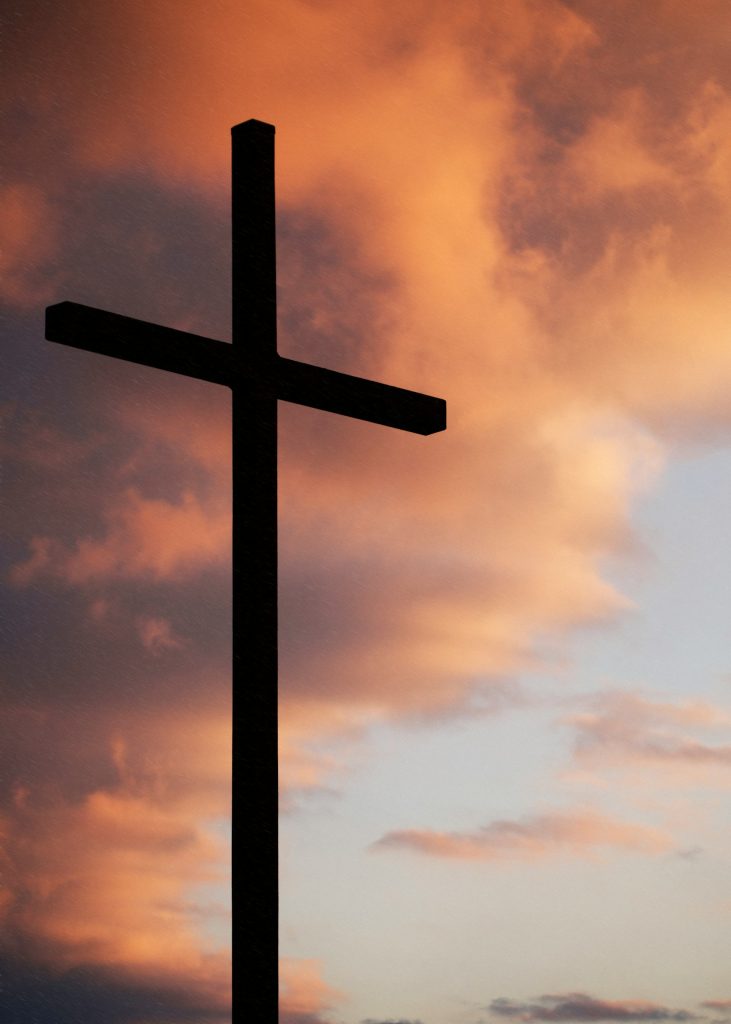
Photo by Aaron Burden on Unsplash
The Intersection We Try To Avoid
And so, we may now look at the cross again, and see that it is not only a distant symbol but a site of unfolding events whose intersection we hover around everyday. And we dodge that intersection again and again by finding just enough of something – some thought, some action, some distraction, some justification – to not enter it.
But, very occasionally, the body, under pressure, gives. The weight of life pressing horizontally – fatigue, pain, limitation – becomes unbearable. And at that time, something that does not belong to that weight – grace – opens from within it, without actually removing it.
And it happens right there in the body.
You see, grace does not take us out of the world. Rather, it allows the world – finally – to appear. It does not erase gravity or the ego. It suspends them, if only briefly, perhaps long enough to shed some of the gravity and reorganize some of the ego’s priorities and demands.
Perhaps this is why, without quite knowing it, we have been yearning for it all along – whenever we grow tired of trying to hold everything together.
And perhaps, this gives us a clue as to how we might invite grace more intentionally into our lives.
Interested in Mentoring?
EACH MONTH, I work with a small number of people (about 6) in a mentoring capacity. It is highly personalized and uses a body-centred phenomenological (lived experience rather than theoretical) approach and draws on mindfulness and reflective practices. If this sounds interesting to you, you can find out more here.
Interested in Meditation or Workshops? Get in touch!