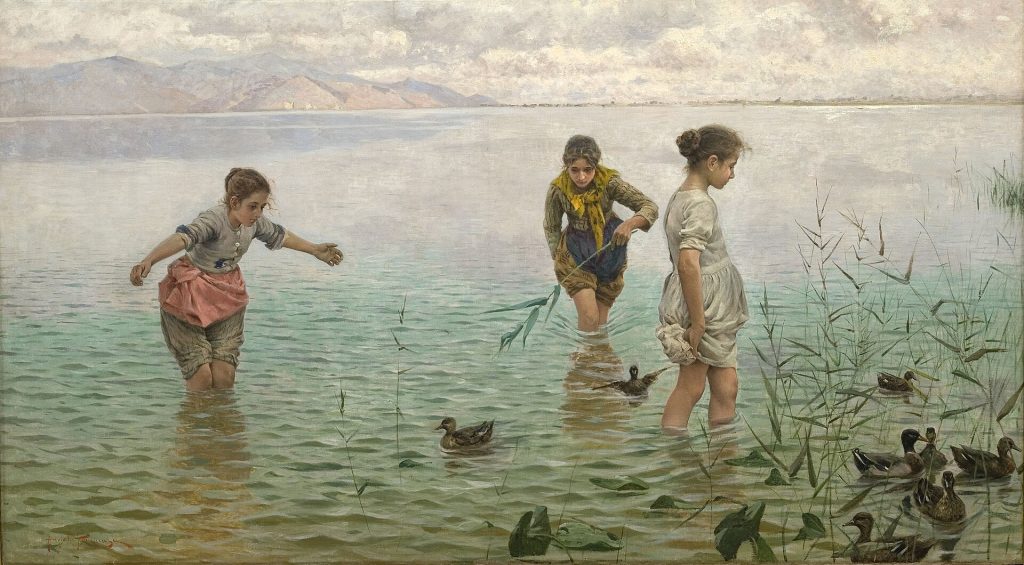
Angelo Tomasi, Wikimedia Commons
There’s a way of being that we almost never name. Not because it’s rare. But because it’s so constant that it escapes our notice.
Before we analyse anything, before we form an opinion, before we decide what something is, there is already a quiet participation happening. A kind of being-with.
You’re not standing outside the world, looking in. You’re already in it. Already involved. Already in contact. Already meaningfully inter-being. Already relational.
This is what I want to call withness.
Before the mind gives meaning
You see, before the mind gives meaning, all of life already is meaningfully related.
We tend to think of experience in terms of distance – physical and psychological.
I look at something.
I speak to someone.
There’s me, here. And there’s you, or the tree, or the table, or whatever else over there.
But that’s not how experience actually begins. Before the ‘at’ and the ‘to’, there is something softer, more immediate, more spacious, more intertwined…
You and I are already with each other and with all of life
You are with…
With the light falling across the room.
With the sound that reaches you before you notice it.
With the person whose presence you feel before a word is spoken.
Watch what happens when you really notice this.
You’re sitting somewhere, maybe quietly, and there’s a sense of the world not as objects arranged in front of you, but as something you’re inside of.
In case you find this difficult to notice with your eyes open, close them. And you might become aware of a symphony of events already in motion – sounds, light, air temperatures, movement in the space around you…
And as you remain openly attentive – as a presence in and with – breath, heartbeat, hearing, feeling and the subtle movements within you, you realize that you and everything else are participating in the same symphony.
Not observing. Participating.
Not separate. But already entangled.
Not a separate ‘I’ (subject) perceiving an separate ‘You’ (object)
This is what the philosopher and phenomenologist, Maurice Merleau-Ponty, spent his life trying to describe, though he used very different language.
For him, perception isn’t something that happens inside us – in our mind, directed outward. Rather, it’s something that happens between already inter-relating beings.
The body is not a spectator of the world. It is already in the world, woven into it. So much so that the line between ‘self’ and ‘world’ is never as clean as it appears to us.
And in a different way, this is what the philosopher and theologian, Martin Buber, was pointing toward. He said there are two ways of relating:
One is ‘I–It’, where we stand apart, classify, measure, try to understand, manipulate, manage and use.
The other is ‘I–Thou’, where we meet – not as subject and object – but as a living relation.
But even that might be too structured and too formal. Because before we meet, before we even recognize the other as ‘Thou’, there is already something more primordial:
We are already with one another and the world.
Withness doesn’t divide the world
The shift from ‘with’ to ‘at’ or ‘to’ is subtle, but it changes everything. And it happens almost always without our notice.
We rarely ever notice ourselves as participating in a world where our body and the world are already given to us, already pregnant and present, and already meaningfully intertwined.
It is a way of being that conceptual thought can never fully contain, because thought tends to separate what lived/felt experience first reveals as intertwined – the way babies experience the world. And we too, when thought is interrupted, if only briefly.
‘Withness’ is participation and intertwining.
‘At-ness’ is observation.
‘To-ness’ is direction.
You see, our mode of being gets hidden in ordinary linguistic habits. ‘Withness’, on the other hand, may be a way of subverting this habit – by reminding us that subject and object emerge from a more primordial intertwining.
It doesn’t ask: What is this? or What should I do with it? or How does it affect or threaten me? It simply allows what is there to be encountered without stepping outside it. And allowing is why attention, in the deepest sense, feels less like effort and more like yielding.
Simone Weil, the philosopher and mystic, once described attention as a kind of openness – something like waiting without grasping, distancing, separating or othering.
Not reaching out. Not taking hold. But remaining available. It is how withness expresses itself.
You can test this, gently:
The next time you’re with someone, notice the moment before you interpret them. Before you decide what they mean, or what you’ll say next.
There’s a brief, almost invisible space where you are simply with them. No agenda. No positioning. Just presence.
It doesn’t last long because we’re quick to move into ‘at’ and ‘to’. We analyse. We respond. We organise the moment into something manageable.
But that doesn’t mean the withness disappears. It’s still there, underneath – quiet, constant, ever welcoming of your notice.
Withness is not a skill to be acquired
Maybe this isn’t something we need to learn, but something we learn to attend to more consciously – an aliveness we so often miss.
Because if there is a more fundamental way of being than looking at you and the world or talking to you and the world, it is being with you and the world.
And in moments of quiet attentiveness, that may even feel sacred.
Interested in Mentoring?
EACH MONTH, I work with a small number of people (about 6) in a mentoring capacity. It is highly personalized and uses a body-centred phenomenological (lived experience rather than theoretical) approach and draws on mindfulness and reflective practices. If this sounds interesting to you, you can find out more here.
Interested in Meditation or Workshops? Get in touch!