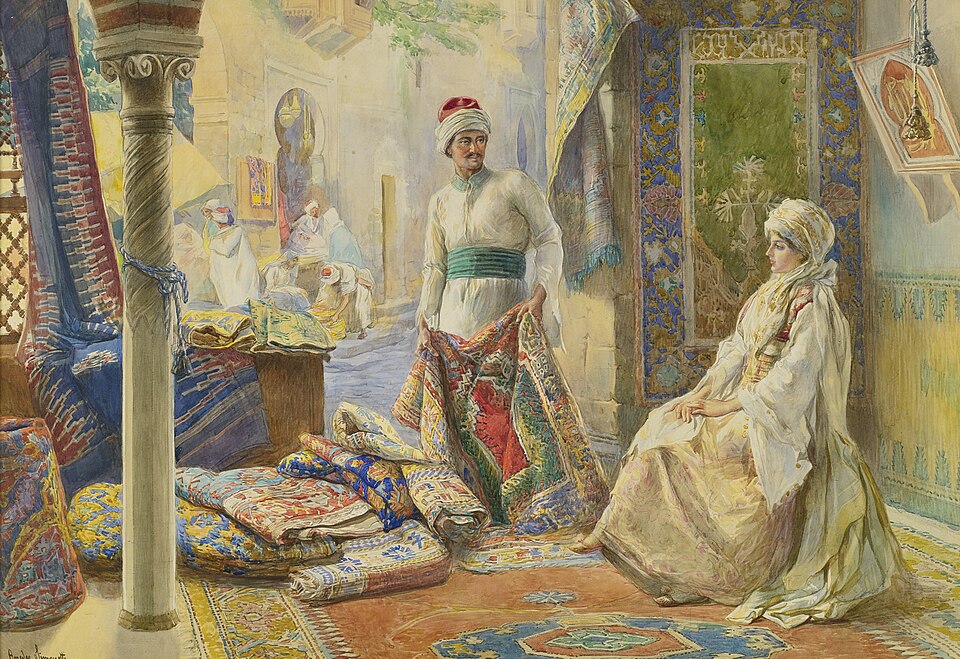
Amedeo Simonetti Wikimedia Commons

There is an ongoing tension that we are caught in, yet hardly ever aware of: the tension between our attempts to co-opt life into our personal dreams, goals and projects, and life’s own unfolding field of participation.
The irony is that we enter the world as a participant in it – that is the disposition of a new born baby in the world into which it is thrown. But, we soon get drawn into the arena of separation where our individual self is set to vie for resources – material, physical, psychological and emotional.
So that now, it becomes normal and necessary to think, speak and act in terms of
My goals
My future
My healing
My happiness
My identity
My journey
We go to bed filled with thoughts, judgments, evaluations and plans for how we might continue to manage and progress this private, individualized project. We wake up assuming there is nothing more pressing and vital to our survival.
For instance, we lie awake replaying conversations we’ve had during the day and which we wish had gone differently. Or we fashion future versions of ourselves. Or we wrestle silently with fears of our certain failure or downfall. Or fantasize about how we might improve our online image…
We even caution and pressure ourselves that if we don’t get our act together, we will be of limited or no use to anyone else and to the rest of the world. And although we do have generous and even altruistic concerns, they mostly serve as background to our very critical and private project of self-identity, self-security and self-satisfaction.
Our Private project and its context
In this private project, the ongoing tasks of self-management, self-improvement, self-protection and self-construction become all-consuming. Our attention turns toward monitoring, optimizing, defending and continually reshaping who we are. Without realizing it, life begins to feel less like participation in a shared world and more like the burden of maintaining a separate self.
But how can I possibly avoid that? You ask. If I don’t take care of myself and put myself first, who will?
There’s nothing wrong with taking care of yourself and putting yourself first. It is necessary. But, it is the context in which we hold and prosecute our self-interest that we need to be clear about. Because the context makes all the difference.
If I don’t put myself first, who will?
You see, the context in which you arrive in this world and in which you walk for the rest of your life is not a container of separated, unrelated or selectively related individuals. Rather, it is an endless field of intertwining lives – bodies, voices, trees, streets, rivers, stones, memories, gestures… each one intimately intertwined with everyone and everything else.
Many of us do not perceive the world in this way though it’s perhaps not an exaggeration to say that many indigenous and pagan cultures had a primal sense of this – in stark contrast to most modern, ‘civilized’ societies.
Instead, our commonly held perception of any ‘thing’ is that the ‘thing’ is ‘out there’ while we are, quite distinctly and separately, ‘right here’. There is hardly ever any sense whatsoever of our intertwining, co-mingling, or ‘withness’ – a word I used in a previous post to describe our relatedness with all of life, well before our thinking tells us so.
How does it matter?
The practical implications of living in attunement with our intertwined nature, our withness, can be both obvious and elusive. It’s obvious when we really give attention to our presence in the world alongside the presence of everything else. For example,
When I notice that I am in the presence of a tree, just as much as the tree is in my presence, I am attuned to our withness.
Or when I notice how a sound travels through the air and through my body rather than assuming it arrives to my ears from out there, I am attuned to our withness.
When I am conscious of what I dispose of and excrete into the earth, I am attuned to the withness of my body, food and earth.
In these and so many other ways, I participate with all of life as part of life. And this is important. Why?
Because my relationship with life shifts from one of separation, independence, isolation, acting on, demanding from – in short, a personal and private sovereignty – to a shared belonging and participation with all forms of life.
That means that I am less inclined to see the world as being in service to me. Rather, I experience myself and the world as belonging to each other and as participating in our mutual care, coherence and unfoldment.
Now, that is not a common way of perceiving our relationship with the world. Historically, though, many human cultures appear to have retained a stronger sense of mutual belonging with the world than is common in many modern societies shaped by competition, ownership and sovereignty.
In these modern ecosystems, private and individual interests can and often do override collective interests. Frequently, such interests are hidden in language and practices that claim mutuality while enforcing hierarchical structures that normalize inequality and division rather than equity and natural diversity.
Belonging and Participating
What happens when I regard you and everything else in the world as co-participants in a shared life, rather than transactional partners in my private project which I call my life?
I find that my locus of thought, speech and behaviour shifts from a separated, individual, egoic ‘I’ to a more participatory ‘we’.
I’m also inclined to avoid the typical extremes of over-consumption, zero-sum settlements and exceptionalism, to name a few. Instead, you and I become more available to mutually beneficial dispositions of
ambition without isolation
care without martyrdom
individuality without alienation
responsibility without guilt
freedom without separateness
attention as participation
gratitude as realism rather than sentimentality
If you’ve been reading my recent posts (here, here, here and here), you’ll see how the philosopher and phenomenologist, Maurice Merleau-Ponty, took a radical turn in philosophy with some salient observations:
• We are not detached spectators looking upon a world to which we give meaning
• We are in a world of bodies and things that are already in meaningful relationship with each other well before thought represents it
• Our relationships in and with the world are intertwined and constantly unfolding
• No being exists independently of the world of relationships in which it emerges and participates
You can confirm these observations yourself by paying attention to things such as
• The way you avoid bumping into someone without having to think about it
• How the lighting or music in a room affects the way you move, where you sit and how you feel even without conscious reasoning
• How you assume the wholeness of an object such as a tree while viewing it from only one angle at a time
the interweaving Structure of Life
These and countless other moments and movements in our lived experience point to the pre-reflective/cognitive nature of meaningful relationships that bodies and things in the world already participate in.
And with just a few such observations, you are likely to appreciate the interwoven structure of life and the interwoven nature of our presence in the world of bodies and things.
And once you do, how then are you to continue to sustain a worldview that tells you we are otherwise?
One that persists with the fantasy of separation, individual and private sovereignty and its personal and collective emotional, psychological and physical toll – anxiety, insecurity, isolation, over-consumption, greed, starvation, destruction of people and things that don’t appear to have a personal bond with us, to name but a few?
We are caught up in the world and we do not succeed in extricating ourselves from it in order to achieve consciousness of the world
Maurice Merleau-Ponty
I think we will have to loosen our claim on life as our private, individual project. I think we will have to seriously consider life as active and intentional participation in which every form of life, including the natural world, is an equal participant.
And when we do, we might discover that this endless field of intertwining beings – bodies, voices, trees, streets, rivers, stones, memories, gestures, conversations and so on – is not something outside us. It is, in a quietly astonishing way, the breath that fills our lungs, the blood that courses through our veins, and perhaps even the meaning that makes life not just tolerable, but fulfilling.
Interested in Mentoring?
EACH MONTH, I work with a small number of people (about 6) in a mentoring capacity. It is highly personalized and uses a body-centred phenomenological (lived experience rather than theoretical) approach and draws on mindfulness and reflective practices. If this sounds interesting to you, you can find out more here.
Interested in Meditation or Workshops? Get in touch!